
Lee Projected Versus Actual Release
A projected date is an agency's current calculation. It is not the event itself. IDOC's “Projected Parole Date” estimates the move from an institution to parole, mandatory supervised release, or a similar community stage. Its “Projected Discharge Date” estimates the later end of sentence and supervision. The actual exit occurs only after IDOC completes release processing and resolves any holds.
A Lee County Jail detainee may have no fixed projected date. Pretrial release turns on the court's order and any other hold. A local sentence uses the jail and sentencing records, not an IDOC projection. Transfer from the jail to Dixon Correctional Center or another authority is a custody change, not a community release.
Find Lee County Projected Release
For an IDOC sentence, begin with the Individual in Custody Search. It accepts a last name, an IDOC number, or a birthdate in MM-DD-YYYY form. A full or partial last name may work. Confirm the IDOC number and identity before reading the profile because common names can produce several records.
- Confirm that IDOC, not Lee County Jail, holds the person.
- Search by IDOC number when available, then verify name and birthdate.
- Read current status and location before the projected fields.
- Record when the profile was checked because projections can move.
- If the person is fully discharged and absent, request archived IDOC data.
| Field | Form | Purpose |
|---|---|---|
| Last name | Full or partial | Broad name search |
| IDOC number | Agency identifier | Best match when known |
| Birthdate | MM-DD-YYYY | Identity check |
| Status and location | Result field | Custody or parole context |
| Projected dates | Profile fields when present | Current estimate only |
The official search entry is shown below. Open the live IDOC date-search source because maintenance and data updates can affect access.
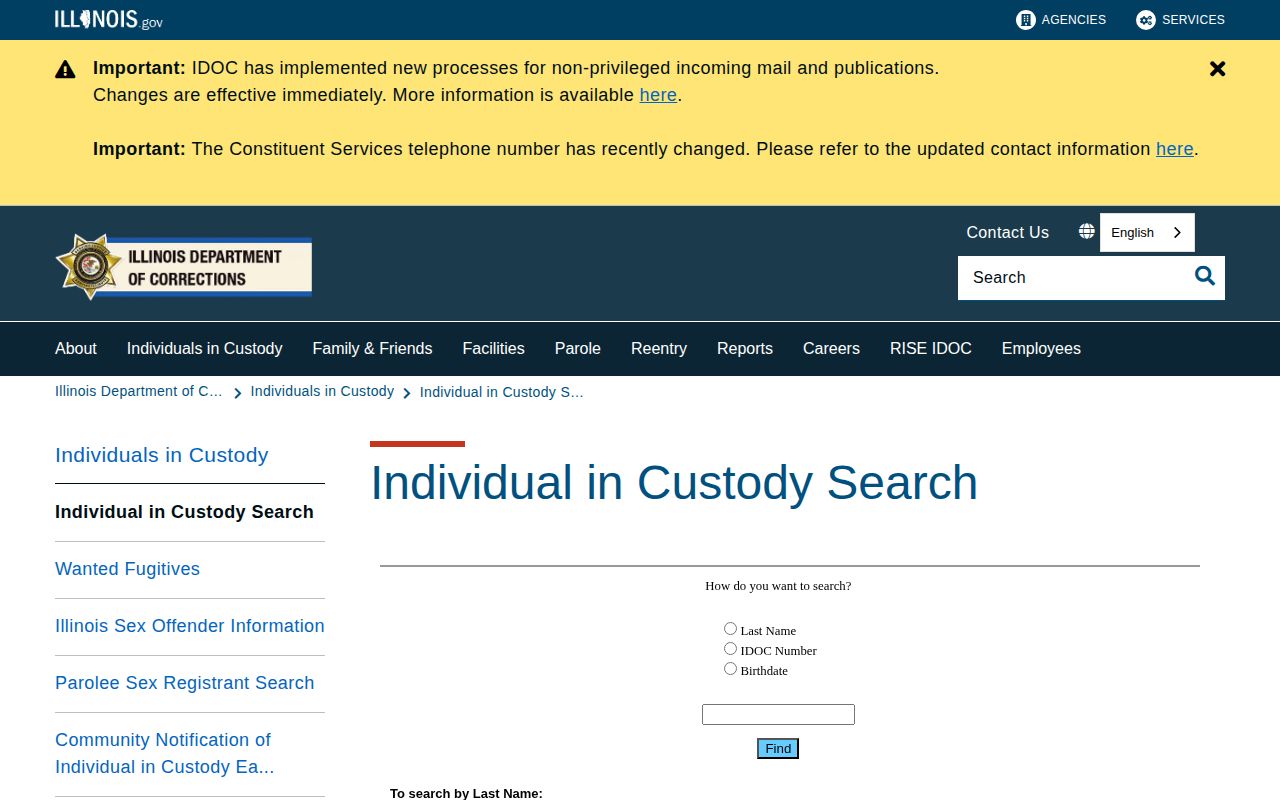
The capture identifies the proper state doorway. Only the named profile supplies the projected labels that currently apply.
Note: IDOC search availability may vary during maintenance or data updates, so preserve the date of each lookup.
IDOC also provides a public-information fallback at 217-558-2200 when the online tool is unavailable or the displayed fields are unclear. Parole-agent matters use a different route at 800-666-6744. A caller should have the IDOC number, full name, birthdate, and current or former facility ready. Staff may limit what can be disclosed, but the correct identifiers reduce the risk of confusing two people with similar names.
How IDOC Computes Lee Releases
IDOC starts with the court sentence and custody history. The calculation can include jail credit, the governing statutory credit rate, earned or program credit, disciplinary loss or restoration, and whether multiple terms run together or one after another. Detainers, new sentences, court action, and release-plan approval can also affect the date.
A detainer is a request from another authority to hold or transfer the person. It can prevent a projected exit from becoming a community release. Consecutive sentences run one after another. Concurrent terms run at the same time. Sentence credit reduces qualifying time under law or agency rules, but eligibility does not ensure every possible credit will be awarded.
- Projected parole date
- IDOC's estimate for the institution-to-community stage.
- Projected discharge date
- The estimated end of sentence and supervision.
- Sentence credit
- Time credited under law and agency rules.
- Detainer
- A hold or transfer request from another authority.
Illinois Credits Shape Lee Dates
730 ILCS 5/3-6-3 contains Illinois's sentence-credit framework. Some qualifying terms can receive one day of statutory credit for each day served, often called day-for-day credit. Other offense and date combinations have stricter floors. Listed cases may require all of the term, limit monthly credit to a level commonly described as an 85-percent floor, or apply 75-percent treatment.
Those categories are not shortcuts for estimating one person's release. The offense, offense date, sentence, exclusions, and IDOC computation control. Illinois law also authorizes discretionary earned sentence credit within set limits for qualifying terms. IDOC states that eligibility creates no expectation of an award and that it cannot forecast whether or when a person will receive one.
Program and educational credit may affect a calculation when allowed. A disciplinary decision can remove credit, while later agency action may restore some of it. The public profile should be read as the current official estimate, not recomputed from a news report or an old court summary.
Note: Credit eligibility does not guarantee that IDOC will award the maximum amount authorized by statute.
The statute also authorizes discretionary earned sentence credit, subject to eligibility and exclusions. The researched limits include up to 180 days for a term under five years and up to 365 days for a term of five years or more. These figures describe possible statutory authority, not an award for a named prisoner. IDOC makes the individual decision and may decline to forecast it.
Why Lee Release Dates Change
A projection reflects the facts in the record at that time. IDOC may revise it when a court corrects a sentence, the agency receives missing jail-credit data, a credit is earned or withdrawn, or multiple sentences are recalculated. Release planning can also change the practical exit date. A proposed residence or community placement may require review.
| Factor | Possible effect |
|---|---|
| Court correction | Changes the controlling term or credit |
| Earned credit | May move an eligible estimate earlier |
| Discipline | May remove or later restore credit |
| New sentence | Can add concurrent or consecutive time |
| Detainer | Can cause transfer instead of community release |
| Release plan | May delay the institution-to-community step |
A PRB decision can affect an eligible traditional parole case or supervision conditions. Many modern determinate sentences instead move to MSR under statute without a discretionary parole grant. Match the sentence type before treating a hearing date as a release date.
Dates can also differ because the projected parole and projected discharge fields measure different stages. A change to the institution exit does not necessarily move the sentence-completion date by the same amount. Read both labels, the status, and any parole location as one record. If a saved copy conflicts with the live profile, the newer agency record deserves follow-up rather than an assumed explanation.
Lee County Jail Computation
County-jail calculation is separate. The current Lee County jail PDF is a custody snapshot with names and booking numbers, not a release calendar. A person held before trial may leave through a judicial order. Someone serving an eligible local sentence may receive credit under the County Jail Good Behavior Allowance Act, but that is not the IDOC projected-parole formula.
Ask the jail or sentencing court for the actual local computation. The Lee County release-record search covers the jail, court, VINELink, and Sheriff records-request routes. A roster disappearance alone cannot show whether the person was released, transferred, or held elsewhere.
The court docket is strongest for the legal order, while the jail record is stronger for the physical custody event. A judge may authorize release, yet another warrant or detainer can prevent a community exit. Conversely, a current-list update can lag or omit historical detail. Requesting the booking and release sheet with the case number helps connect the order to the jail's actual action.
| Custody path | Date source | Limit |
|---|---|---|
| Lee County Jail | Jail record and court order | Roster has no projected date |
| Dixon or another IDOC prison | IDOC profile | Projection can change |
| Federal BOP custody | BOP locator | BOP-only status |
| ICE custody | ICE locator and contact | Not a permanent archive |
Note: Lee County jail credit and IDOC sentence credit follow separate statutes and agency calculations.
Archive Lee County IDOC Release
IDOC's public search includes people incarcerated or on parole. After final discharge, the profile drops from view. A no-result may therefore reflect a spelling issue, an outage, no IDOC history, or completion of the state sentence. It does not by itself establish which explanation is correct.
Use IDOC's Contact Us form with “Record Search” for a former IDOC person. Provide full name, birthdate, approximate reception year, facility, conviction county, and relevant dates. IDOC identifies admission and release dates, status, IDOC number, and sentencing information among the data that may be disclosed, while protected material may be withheld.
IDOC maintains a narrow early-release database for certain exits from March through December 2020 under specified credit or electronic-detention programs. It is a bounded legacy source, not a current release calendar and not a complete history of Illinois prison exits. Written agency verification remains the better answer for a named former prisoner outside that defined period.
Confirm Lee County Actual Release
Near the expected date, check the profile again and confirm with the actual custodian. Processing, property return, transport, plan review, and unresolved holds can affect the event. VINELink can provide prospective custody-change alerts when a person and agency participate, but it is not a guaranteed historical release archive.
A person entering MSR or parole has left institutional custody but has not finished the sentence. The Lee County probation and parole page explains which office handles that supervision. Final discharge is a later milestone and should be confirmed through the agency record.
For a Lee County Jail event, combine the jail's custody statement or release sheet with the court order. VINELink can add a prospective alert when registration occurred before the event. A court order establishes legal authority, but a separate hold may still affect physical departure. For an IDOC event, the live profile, institution response, and later archived release data form the stronger chain.
Federal and immigration dates require their own custodians. A BOP locator result applies to federal BOP custody, and an ICE result applies to ICE custody within that system's scope. Neither source proves that another authority did not assume custody next. State, county, federal, and immigration dates should not be merged into one estimate.
Document Lee Release Date Checks
Record the date and source of each lookup. IDOC fields can change after recalculation, and the Lee County jail PDF is replaced as the current population changes. A dated note should state whether it came from the live profile, a court order, a custody call, a VINELink event, or an archived response. That detail prevents an estimate from being repeated later as an actual release.
Use stable identifiers in any follow-up request. An IDOC number points to a state record, a booking number points to the county intake, and a court case number points to the judicial matter. These numbers are not interchangeable. When several cases or custodians exist, ask each office only about the event it controls.
A release date also needs a release type or destination when available. Community release, transfer to IDOC, transfer to another county, and handoff on a federal or immigration hold can all remove a person from a local roster. The date alone cannot distinguish those outcomes. The originating release sheet is the best place to seek that context.
Note: A roster disappearance cannot distinguish community release from transfer, another hold, or movement to a different custodian.
Public Record Search
Sponsored Results