
Lee County Parole or Probation
Probation is a sentence administered through the court. In Lee County, Probation and Court Services works under the Chief Judge of the 15th Judicial Circuit. Parole and mandatory supervised release, often shortened to MSR, follow an IDOC prison term. IDOC's Parole Division supervises those cases, while the Illinois Prisoner Review Board sets conditions, handles revocation matters, and makes traditional parole decisions for the limited population still eligible for them.
A county jail departure does not identify the form of supervision. Someone may leave the Lee County Jail on pretrial release, after completing a local term, on probation, by transfer, or because another authority took custody. Likewise, leaving Dixon Correctional Center for MSR is not the same event as a local probation sentence. The court docket and the custodian's record must be read together.
| Supervision | Authority | Best first record |
|---|---|---|
| Lee County probation | 15th Judicial Circuit and Lee County Probation | Circuit Clerk case disposition |
| Parole or MSR | IDOC Parole Division and PRB | IDOC Individual in Custody Search |
| Final discharge | Agency that held the record | Court record or IDOC archived Record Search |
- Probation
- A court sentence served under local court supervision instead of, or after, confinement.
- Parole
- Conditional community release used for eligible older-law Illinois sentences.
- Mandatory supervised release
- A required supervision term after an IDOC prison term.
- Discharge
- Completion of the sentence and supervision obligation.
Verify Lee County Supervision
Start with the system that last held or sentenced the person. The IDOC Individual in Custody Search accepts an IDOC number, birthdate, or full or partial last name. Although its title sounds custody-only, IDOC says it also includes people on parole. A parole location or status can show that institutional custody ended while state supervision remains active.
The IDOC public display has a firm limit. It covers people incarcerated or on parole, then removes a person after final discharge. An absent profile therefore cannot prove that no IDOC history exists. Use IDOC's Contact Us route with the subject “Record Search” for archived admission, release, status, and sentencing information. A county-only release may never appear in IDOC at all.
- Identify the last custodian: Lee County Jail, IDOC, or another authority.
- Search the Lee County court docket for the sentence or latest order.
- For an IDOC case, compare the state profile's status, location, and projected fields.
- For probation, contact the local office only after confirming the court disposition.
- For a discharged IDOC person, request an archived Record Search response.
The Lee County released-inmate search and records overview explains how to confirm a county jail exit before checking supervision. It also distinguishes release into the community from transfer to Dixon Correctional Center or another custodian.
Lee County Probation Reporting
Lee County Probation and Court Services is not a public name-search database. Its role begins after the 15th Judicial Circuit orders probation. The office's FAQs direct clients to report on time and speak directly with their probation officer if an appointment must change. A family member or other caller should not expect staff to disclose protected case details.
309 S. Galena Avenue, Suite 400
Dixon, IL 61021
815-284-5247
Monday-Friday, 8:00 a.m.-noon and 1:00-4:30 p.m.
The official probation page shows the local reporting route and office hours. The image below comes from that Lee County probation source.
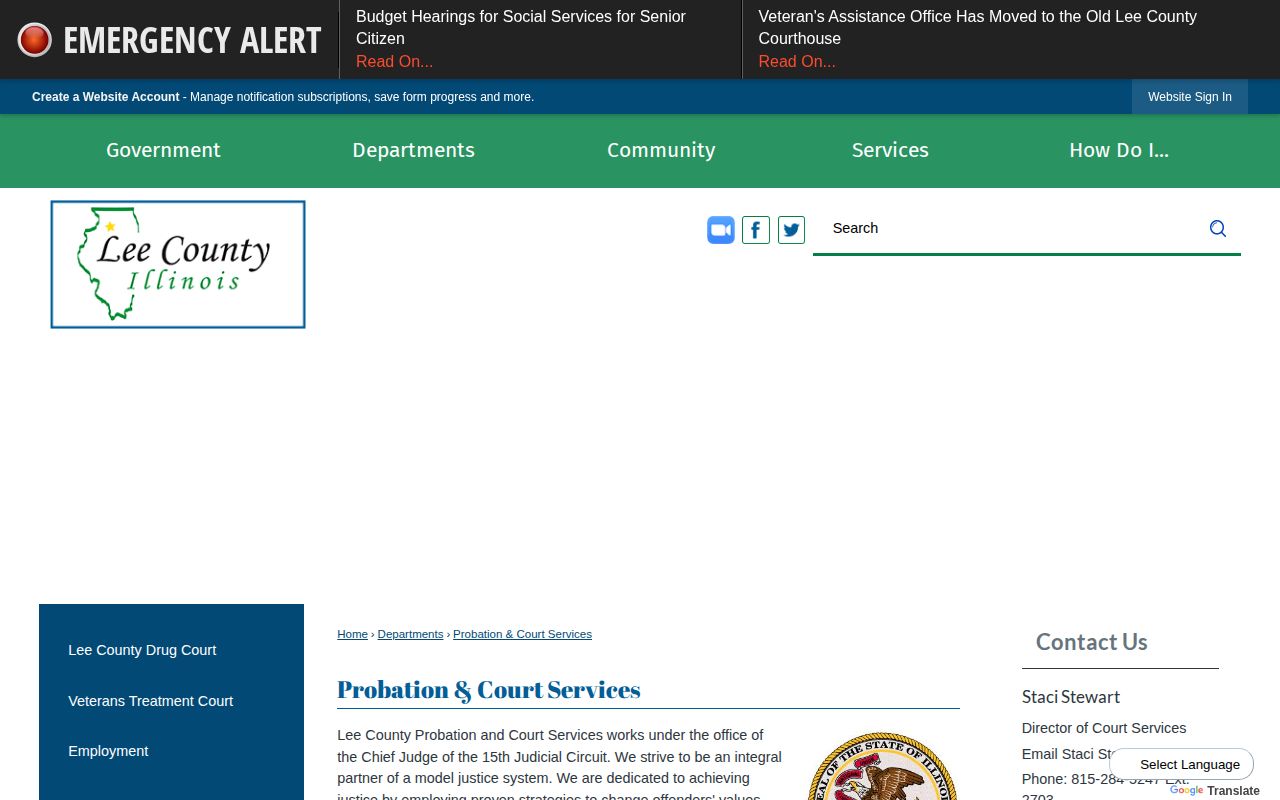
Use the office details after the court record confirms probation, not as a substitute for the docket or an IDOC status check.
Note: Lee County Probation has split weekday public hours and is not a public name-based probation search.
Lee County Parole Record Route
IDOC parole and MSR issues follow the statewide route. The public-information line is 217-558-2200, while IDOC routes parole-agent calls to 800-666-6744. The IDOC Parole Division page provides current office navigation. When a profile is visible, read the stated location and status rather than inferring supervision from a projected date alone.
The public search form is shown in the successful official-source capture below. It illustrates the IDOC entry point, not a promise that every former prisoner will remain searchable. View the current IDOC offender search before relying on its fields.
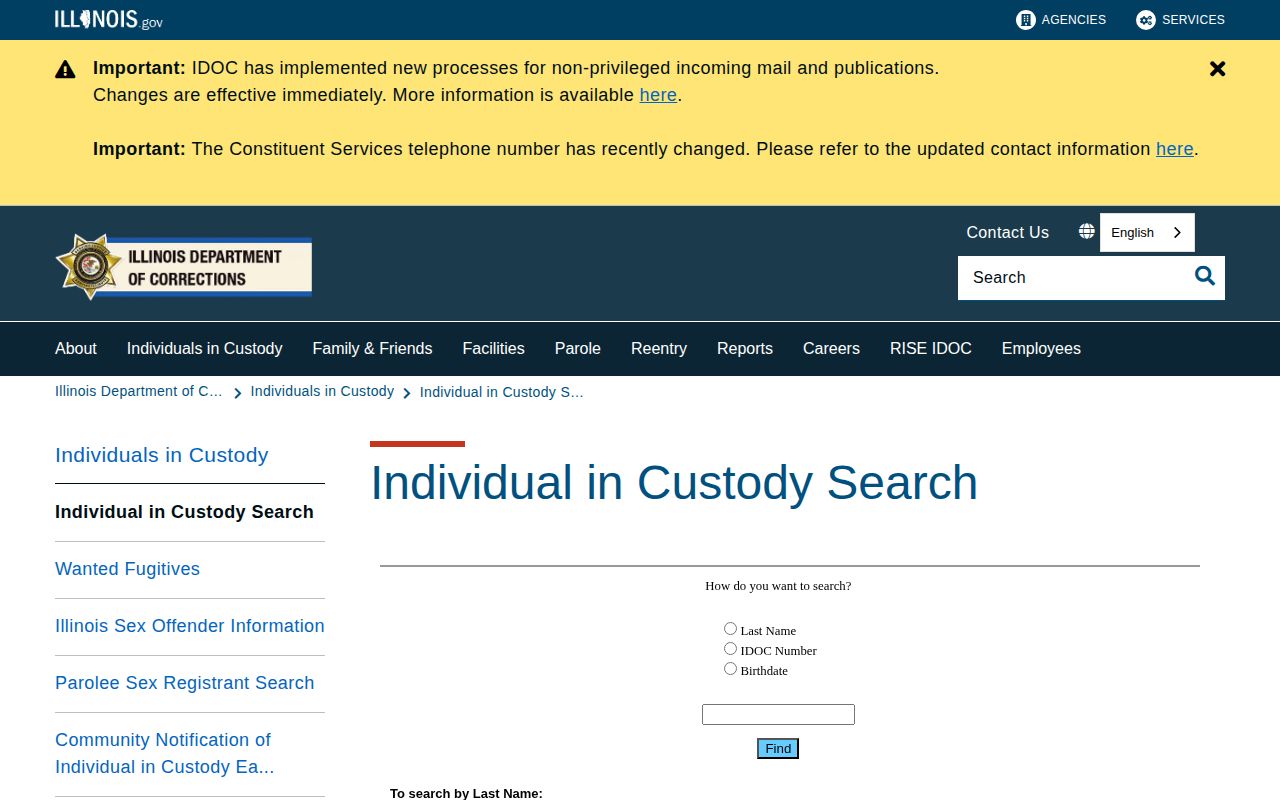
A Lee County Jail booking with no state commitment will not be found there. A transfer into IDOC custody is also not a community release.
When the state profile does not settle the issue, compare it with the Lee County Circuit Clerk case. A committing case can show the sentence behind IDOC custody, but it cannot replace the state exit record. For a person who has completed parole or MSR, ask IDOC for archived admission and release information through Record Search. That response is the durable route after the public profile disappears.
Lee County Supervision Violations
A supervision condition is a rule imposed by the court, PRB, or supervising agency. A revocation is an official decision that supervision has been withdrawn after the required process. An absconder is a person alleged to have stopped reporting or left supervision, not merely someone absent from a jail roster or online profile. Only the responsible agency can confirm that status.
Report an urgent safety concern to local law enforcement. For a state supervision question, use IDOC's verified parole channels. VINELink may send custody-event notices, including release or transfer, but it is not a public list of all people on parole and it does not settle whether a supervision violation occurred.
PRB handles revocation functions for parole and MSR. Its posted schedules and result documents can help with an eligible matter, though they do not form a single all-case name search.
Note: A jail-roster absence does not establish an absconder finding or any other supervision violation.
Lee County Parole Hearing Records
The Illinois Prisoner Review Board publishes an annual En Banc calendar, past-paroles material, indeterminate open minutes, revocation schedules, and monthly revocation results. The 2026 calendar lists monthly morning meetings in Springfield and warns that dates can change. At the research review, the En Banc results route lagged behind the calendar, so no page should promise real-time decision results.
Modern determinate sentences commonly lead to MSR under statute rather than a discretionary grant at a parole hearing. Traditional parole eligibility is limited, and PRB does not decide a discretionary release date for every person at Dixon Correctional Center. Match the person and sentence type before treating a meeting notice as relevant.
For an eligible case, compare the dated PRB document with the live IDOC profile and the sentencing record. A meeting result can explain a Board decision, while IDOC remains the better source for present custody or active state supervision.
Dixon Release Reentry Programs
Dixon Correctional Center's official IDOC facility page identifies institution-based programs meant to support functioning in the community after release. That source is useful for navigation, but it does not promise that a named person completed a program, qualified for it, or received a specific transition service.
Ask IDOC or the institution for the program and transition record tied to the releasee. Program participation does not replace the formal IDOC release date, parole location, PRB condition, or final discharge record. It also does not turn a transfer between IDOC institutions into a release.
Correct Lee County Supervision Identity
Names alone can create bad matches, especially when a county roster offers little more than a name and booking number. Compare birthdate, IDOC number, case number, and agency before connecting a supervision record to a person. Preserve the source entry and the identifiers used if a correction is needed.
Illinois law on expungement and sealing includes an identity-theft correction mechanism. It can remove an identity-theft victim's name from arrest or conviction records and insert the offender's name if known. Ordinary errors should be sent to the Sheriff, Circuit Clerk, IDOC, or probation office that owns the record.
Note: Match birthdate, case number, booking number, and IDOC number before connecting a supervision record to a person.
Lee County Supervision Discharge
Supervision ends through the order or record of the responsible agency. A probation case may close through a Lee County court disposition. An IDOC parole or MSR case reaches final discharge under the state sentence. The projected discharge date is an estimate until the agency records completion.
Once IDOC supervision ends, the person may disappear from the public search even though archived admission and release information remains requestable. For local probation, check the Circuit Clerk's case history and any closing order. For either system, an old profile or roster copy should not override the originating agency's current record.
Keep each conclusion narrow. A probation closing order confirms the court-supervision outcome stated in that case. An IDOC discharge record confirms completion of the state sentence reflected by IDOC. Neither record proves the status of an unrelated federal matter, immigration hold, or separate county case. When records conflict, use the case number, IDOC number, dates, and issuing office to determine whether they concern the same person and event.
Cross-Check Lee Supervision Records
A reliable supervision check uses more than one matching identifier. Compare the court case number, birthdate, IDOC number, sentence date, and agency location. The Lee County docket can establish probation or commitment, while IDOC establishes state custody, parole, MSR, and discharge within its system. VINELink adds custody-event notice but is not a full supervision registry.
When two sources differ, note when each was updated and ask the office that owns the disputed field. A court clerk can address the judicial case entry. IDOC can address its status and release fields. Lee County Probation can address local reporting within its disclosure limits. This division keeps a county probation case from being mistaken for state parole.
Note: Each office can confirm only the court, custody, or supervision record that it owns.
Public Record Search
Sponsored Results